
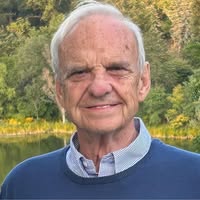
By Rosalind Russell – A former resident of Espanola has been named to the Order of Canada.
Charles A. Hopkins was appointed as a member of the Order of Canada on New Years Eve for his significant contributions to education for sustainable development.
Born in 1940 in Parry Sound, he grew up in Espanola, attended Espanola High and in 1999, following a career as a principal and superintendent, became the inaugural UNESCO Chair in Reorienting Education towards Sustainability at York University in Toronto.
Officials say he received the Order of Canada for his work as a pioneer in applying sustainable development concepts to education.
Hopkins currently pursues research with a focus on the whole-institution approach towards sustainability as recommended as a promising tool to create holistic changes by UNESCO.
He has also received honorary doctorates from Uppsala University in Sweden (2006), the National University of Trujillo in Peru (2011), and Okayama University in Japan (2019).
In 2022, he received a Clean 50 Lifetime Achievement Award for his efforts in connecting education to business and industry in Canada and globally.
Hopkins had previously worked for the Toronto District School Board as the principal of the Island Public/Natural Science School and the Boyne River Natural Science School, as a regional school superintendent, and as superintendent of curriculum.
When the UNESCO Chair for Reorienting Education towards Sustainability was established in 1999, he was the first chair ship to focus on ESD. .
The United Nations General Assembly has recognized ESD as a key enabler of all 17 Sustainable Development Goals.
Hopkins was one of the first to apply overarching concepts of sustainable development to education.
His advocacy for ESD has included speeches promoting outdoor education in the 1960s and international involvement in developing environmental education in the 1970s.
Hopkins also advocates for hands-on engagement as a teaching tool, and in a 1973 textbook for elementary students, he emphasized school development and neighbourhood exploration as a way for students to become engaged in hands-on learning, which was presented to the Brundtland Commission in 1986.
As part of the UN preparation for the Earth Summit in Rio de Janeiro in 1991/92, together with John Smyth, Hopkins helped draft Chapter 36 of Agenda 21: Education, Public Awareness and Training In 1992, he organized and chaired the World Congress for Education and Communication on Environment and Development Conference (ECO-ED) in Toronto, the first international education and communication conference following the summit. The event was considered one of the ‘Canadian milestones’ in the efforts towards educating for sustainability.
Hopkins has published widely on the importance of engaging education in implementing sustainable development and was an early advocate for this approach.
He has also chaired the writing and adoption processes of two global UNESCO ESD Declarations: the Bonn Declaration on ESD (2009), marking the mid-point of the United Nations Decade of Education for Sustainable Development (UNDESD), and the Aichi-Nagoya Declaration on ESD (2014), which marked the end of the UNDESD and the launch of the Global Action Programme on ESD.
In addition to his ESD work with UNESCO, he worked with the United Nations University Institute for the Advancement of Sustainability (UNU-IAS) in creating the Global Network of the Regional Centers of Expertise in ESD.
Photo provided by Government of Canada – Order of Canada


 Submit News Tip
